

The Month in Reuse: From Ambition to Execution
02 February 2026
If there’s one clear thread running through everything we’ve shared this month, it’s this: reuse has moved decisively from ambition to execution. Across policy, infrastructure, data and real-world trials, the conversation has shifted from “should we?” to “how do we make this work at scale?”
Here’s the story so far.
When Policy Is Clear, Markets Move
The UAE’s nationwide ban on single-use plastics (effective January 2026) has become a live case study in how well-designed regulation unlocks smooth transitions. Early notice, clear scope, and aligned infrastructure meant businesses didn’t scramble, they prepared. Retailers adapted, consumers embraced reuse, and compliance followed quickly.
What’s striking isn’t just the ban itself, but what it enabled: the confidence to invest in systems that eliminate waste altogether. It’s the same pattern we’re now seeing globally, across parts of Europe, the UK, Singapore, and select US states. Policy clarity creates market momentum.

pEPR Is No Longer Theoretical
Packaging Extended Producer Responsibility (pEPR) featured heavily this month as an active reshaping force in food and beverage. Across the UK, EU, and increasingly the U.S., EPR is changing how businesses think about packaging, pricing, and margins.
While pEPR arrives alongside rising costs, the picture isn’t purely negative. Consumers are increasingly willing to support sustainable choices when they understand the why. Clear communication, not quiet price rises, is what protects trust.
What’s emerging is a clear divide. Some brands treat pEPR as a cost to absorb or quietly pass on. Others use it as a forcing function to rethink packaging, improve data visibility, and turn compliance into competitive advantage.
The difference is infrastructure. Businesses that can show how packaging is designed, how often it’s reused, and where it goes at end-of-life are far better placed to manage fees, stabilise costs, and prepare for what comes next. Material substitution alone can only go so far.
Reuse systems shift packaging from a recurring expense to a managed asset and that changes the economics.
News on Reuse: From Commentary to Consequence
This month marked the launch of News on Reuse, our new series tracking the policies, systems and decisions that will determine whether reuse scales or stalls.
Episode 01 focuses on Wales and its proposed Deposit Return Scheme, not as a political story, but as an infrastructure test case. Wales is attempting something genuinely different: a digital-first DRS that includes glass, explicitly supports reuse, and allows multiple verified return pathways. In other words, a system designed for circular flows, not just improved recycling.
The episode unpacks what’s at stake if Wales is blocked from proceeding under the UK Internal Market Act. The implications extend far beyond national borders. This is about whether governments are allowed to test, learn and iterate on reuse infrastructure or whether innovation is frozen at the lowest common denominator.
The question the episode leaves us with is simple but uncomfortable: if regions ready to lead on reuse are prevented from doing so, where does meaningful progress come from?
Deposit Return Systems: Why Digital Changes Everything
Wales has been a focal point this month, and for good reason. With its Digital DRS launching in 2027 and mandatory reuse targets on the horizon for 2031, it’s becoming a global testbed for what modern reuse infrastructure actually looks like.
Deposit Return Systems are often framed as a recycling tool. In reality, they’re becoming the financial and operational backbone of reuse. Traditional DRS models were designed for single-use containers moving in one direction. Reuse flips that logic. Suddenly, return rates aren’t just a success metric, they’re the difference between a system that works and one that collapses under its own logistics.
That’s why national and digital-first DRS frameworks matter so much.
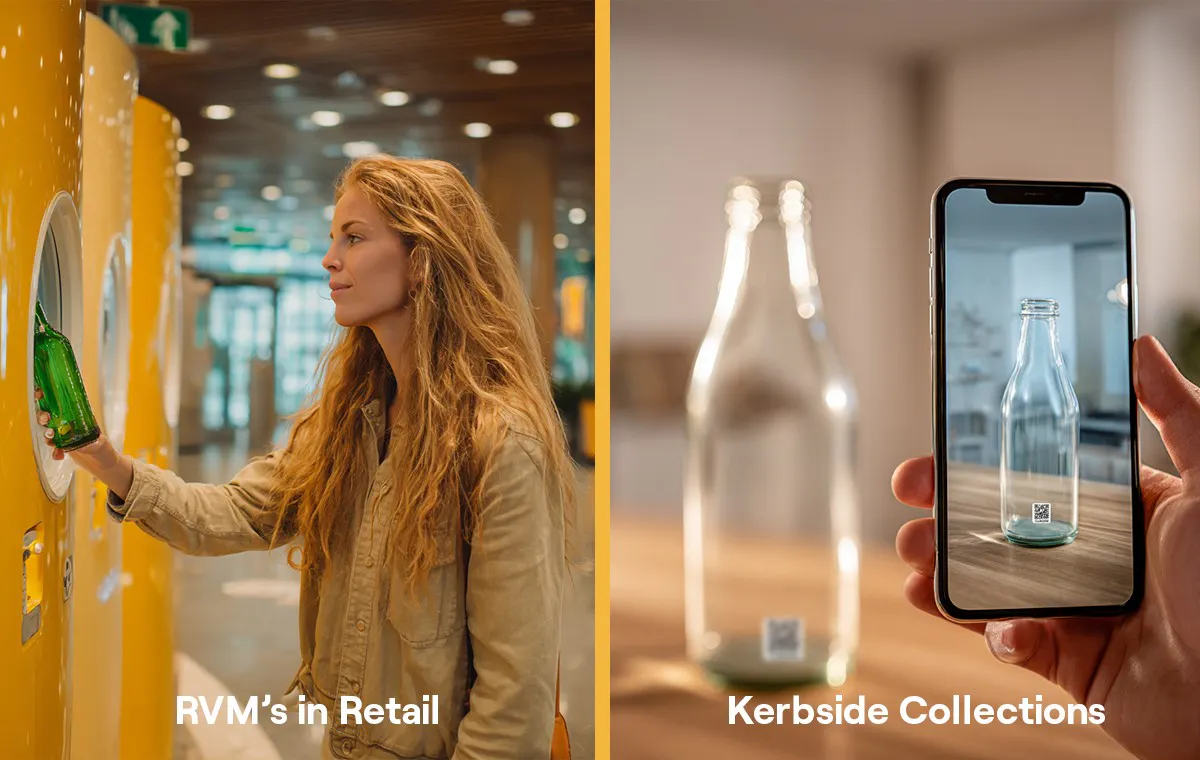
Wales’ approach is particularly instructive. By enabling multiple verified return pathways through in-store RVMs and kerbside collection, they're reducing the friction for consumers while increasing returns for brands and regulators. Early trial data already shows that kerbside returns outperform store-based returns when convenience is prioritised.
But convenience alone isn’t enough. Reuse needs:
- Real-time verification of returns
- Automated deposit return settlement
- Fraud prevention across channels
- Interoperable data that works across brands, retailers, and regions
This is where digital infrastructure becomes the enabler, not the add-on. When deposit returns, packaging returns and tracking sit on a unified transaction layer, reuse stops being “another thing for consumers to think about” and starts behaving like any other modern service: fast, intuitive, and trusted.
CLUBZERØ's proposed Cardiff trial is about proving that reuse can operate with the same reliability and scale as existing retail and payments infrastructure. And once that threshold is crossed, adoption follows naturally.
The Evidence Is Catching Up With the Vision
Insights from research events, live retail schemes, and international pilots are dismantling long-held myths:
- Consumers trust reuse when systems are well designed, intuitive, and consistent across brands and retailers. Adoption follows convenience, not ideology.
- Hygiene concerns largely disappear with standardisation, clear quality controls, and visible system credibility. Where standards exist, confidence quickly replaces hesitation.
- At scale, reuse can outperform single-use on cost, particularly when kerbside logistics are optimised and reverse logistics are planned as infrastructure, not an afterthought.
- Interoperability across brands and retailers is what unlocks true economies of scale, reducing friction, duplication, and system costs while increasing participation.
In short: the barriers aren’t behavioural, they’re infrastructural.
Building Reuse Infrastructure for Scale
Our work this month reflects a clear shift toward interoperable, digital-first reuse systems designed to operate at national scale. From supporting Digital DRS in Wales, to scaling reuse systems in regulated markets like the UAE, to contributing to collaborative initiatives across the UK, EU, and U.S., the focus has been consistent: build once, scale everywhere.
Recognition through a second consecutive FoodTech 500 finalist listing, the U.S. Plastics Pact Reuse & Refill Award, and participation in global innovation showcases signals growing confidence in CLUBZERØ and our approach. But the strongest indicator is alignment.
Regulators, retailers, producers, and technology partners are increasingly working from the same playbook: shared standards, verified data, and infrastructure built for long-term operation. That’s where reuse moves from experimentation to execution, and it’s exactly where CLUBZERØ is building.
The Big Takeaway
This month wasn’t about announcements for their own sake. It was about alignment:
- Reuse has moved from ambition to execution.
- Clear policy is setting direction and unlocking infrastructure investment.
- Data and digital systems are no longer optional, they’re the foundation for scale.
- Convenience and interoperability are what drive adoption and performance.
- Those building the infrastructure now will shape how reuse works next.
Reuse isn’t waiting for permission. The systems are being built and the regions that move first will set the rules for everyone else.
More soon.
